"Theatricality always fascinated Renoir."
—David Thomson, The New Biographical Dictionary of Film (2004)
The theater has intrigued many of the great filmmakers, inspiring them to examine the blurring of the distinctions between acting and life. Impersonation, disguise, deception, and hiding behind a false personality—all of these examples of the irruption of theatricality into real life and staples of many genres in literature and film—are devices found, for instance, in a number of Alfred Hitchcock's thrillers (
The Lady Vanishes,
Spellbound,
Notorious,
Vertigo,
Psycho to name some of the most obvious). Ingmar Bergman was intensely interested in the interplay between personality and performance and probed the subject time and again, from his first masterpiece,
Sawdust and Tinsel, to
Persona to his last theatrical feature,
Fanny and Alexander. Aside from
Persona, few movies I've seen have been so thoroughly steeped in the parallels between the theater and reality and in the concept of life as performance as Jean Renoir's
The Golden Coach (1952).
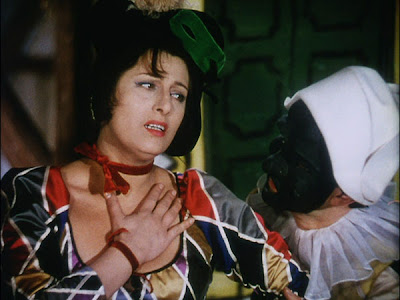
In the movie, the great Anna Magnani plays Camilla, the lead actress in a troupe of Italian
commedia dell'arte players who travel to Peru in the 1700s. When they arrive, they find the whole trip has been a fiasco. There is no theater for them to perform in, the local innkeeper who has engaged them practically places them in servitude to pay off the cost of their passage, the local nobles shun them as too common, and the natives who attend their performances are unskilled in the respectful behavior of theatergoers. Camilla, who has spent the five-month sea voyage sleeping in a magnificent golden carriage being shipped to the colonial viceroy and seized upon it as the symbol of the golden opportunities waiting in the New World, is bitterly disappointed at the bleak reality she finds there.
When the viceroy, Ferdinand (Duncan Lamont), becomes besotted with her, the fortunes of the troupe begin to change. For the rest of the movie, she not only becomes involved in romantic intrigue, but also becomes the center of political intrigue when Ferdinand gives her the coach she covets as a present. This causes a revolt by the nobles, who proceed to depose Ferdinand and sue the bishop, who is the ultimate authority in all such decisions, to support their wishes and order the viceroy's execution.
The movie is part romantic farce, part social farce, and part political farce. These strains intersect in a very funny sequence in which Ferdinand races from room to room as the council of nobles meets in one room in an attempt to force him to sign a decree taking the golden coach back from Camilla and giving it to them, while the furious Camilla waits for him in another room obstinately refusing to relinquish the coach, and her competitor for his affections, Ferdinand's haughty former mistress, a widowed noblewoman, waits in yet another room trying to persuade him to give up the common Camilla and return to her. The sequence is staged, acted, and filmed in a style straight out of French farce.
The viceroy is attracted to Camilla not only by her earthy dynamism and anarchic spontaneity—a sharp contrast to the affected languor of the local noblewomen, with their mannered behavior and highly artificial appearance—but also by the fact that it is only with her that he can abandon his role as a political figurehead and be himself. This is expressed in their first meeting, at a formal dance for the nobility at the viceroy's palace, when he ushers Camilla to a secluded balcony and removes his wig, complaining that it's far too hot to wear something so absurdly uncomfortable. With everyone else he is formal and calculating, forever in the midst of a political or romantic power game in which he must be constantly on his guard to press his advantage and protect his position. But with Camilla he relaxes, and in the entire movie, it is only when he is with her that he ever laughs.
The central irony of the movie is that the nobility are in a way professional performers just like the actors, their lives governed by prescribed conventions of behavior every bit as formulaic as the set plots of
commedia dell'arte that Camilla and her troupe perform nightly. The difference is that the actors have a real life when they are not onstage, and the nobles don't. For the professional performers, there is a clear distinction between acting and being. For them these are discrete states: they are either "on" or "off."
In the lives of the nobility, by contrast, this distinction does not, indeed cannot, exist. They are always "on," always performing, and they don't even seem aware of it. Everything about them—their arch posing, elaborate wigs and attire, pompous manners and diction, and stately dances—exists to sustain the grandiose illusion of entitlement that keeps them in power and wealth. The actors know the difference between acting and life and drop their stage roles when they are not working, but the nobles can never afford to drop their masks, for it is through the manipulation of appearances that they maintain their control over society.
For the viceroy and the other nobles, the golden coach itself is a symbol of privilege. Ferdinand freely acknowledges that this was the purpose of ordering the coach, as a symbol to impress upon the natives (and even though he doesn't say so, clearly upon the other nobles) his social and political status, to remind them as they see him riding in it of the hierarchical power structure of colonial Spain and of his own supreme position in the colony. This is why the nobles become so incensed when Ferdinand gives the coach to Camilla, because he treats it as a personal possession, not as a symbol of power and wealth. And they tell him openly the reason they insist on having it for themselves is the impression it will make on the natives when they see their social superiors riding in it—yet another example of illusion and performance merging with reality.
Romantic complications ensue when Camilla, already being pursued by Felipe, the leading man in her troupe, becomes involved not only with the viceroy, but also with the local celebrity, a toreador named Ramón. While attending a bullfight (itself another kind of highly ritualized performance), she becomes so caught up in the drama of the situation that she impulsively throws the golden necklace the viceroy has given her to the victorious toreador, who interprets it as a token of her affection. In another farcical and highly theatrical scene, in the background Felipe and Ramón fight a duel over Camilla with swords while in the foreground the viceroy, who has refused to give in to the demands of the nobles over the coach and resigned himself to the loss of his power and his life, says goodbye to Camilla on the night before the bishop arrives to sign his death warrant.
But in the end the viceroy is not deposed or executed. The resourceful Camilla outwits all of her noble adversaries by grasping, as they do not, the power of theater over life. How, you may be asking, does she put this knowledge to practical purpose? By recognizing that there is one powerful person with more invested in the maintenance of position through symbolism, ritual, and performance than the nobles themselves: the bishop, the man who has the final say in all that happens in the colony. For what could possibly be more theatrical than the pageantry of the Roman Catholic church? Costumes, props, music, stylized movement, elevated language—the church incorporates in its rites the same elements as the theater. By making a gift of the golden coach to the bishop, Camilla not only saves Ferdinand's life, but proves herself the most masterful dramatic strategist—and plotter—of the lot by correctly gauging the irresistible appeal of the coach's grandeur to the bishop's vanity. In thanking Camilla for her gift, the bishop actually says with a straight face that now when he is driven to give the last rites to a dying peasant, he will arrive in a vehicle befitting his position as spiritual head of the colony!
The Golden Coach benefits greatly from its Technicolor cinematography by the director's nephew, Claude Renoir, who worked with Jean Renoir on several of his movies. Filmed at Cinecittà in Rome, the movie has a gleaming, silvery glow that mirrors the sunblanched desert tones of the sky, sand, stone, and stucco of its setting. The film also benefits from the music of Vivaldi, which is contemporary with its setting and which Renoir says he used as an inspiration while planning the movie. But above all it benefits from the presence of the magnificent Anna Magnani. When unrestrained, Magnani can sometimes be just a bit
too much larger-than-life. But here she has just the right amount of exuberance, willfulness, and voluptuousness. It's easy to see why the viceroy becomes so enamored of her, for her appeal shines through not so much in physical beauty as in her sensuousness, her liveliness, and her robust enjoyment of life—all qualities lacking in the effete noblewomen the viceroy normally socializes with and romances.
But most of all, Magnani's beauty is expressed through her huge, soulful, bovine eyes. Nowhere is this more apparent than in the final scene of the movie. Like Olivier's
Henry V,
The Golden Coach opens and closes in a theater, and the entire movie is framed as a stage performance. In the last scene, the curtain descends, and the camera draws back to show the proscenium. Don Antonio, the manager of the troupe, stands to the left and delivers an epilogue on the superiority of the theater to "so-called real life." As the camera moves in for a medium close shot of Magnani, standing dead in the center of the stage in front of the curtain, she mutters distractedly, "Felipe, the bishop, Ramón, the viceroy . . . disappeared, gone."
"Do you miss them?" Don Felipe asks her.
"A little," she answers wistfully, raising those dark, melancholy eyes and looking directly into the camera, which lingers on her face in a haunting final shot that in its power and beauty rivals the last shot of Garbo in
Queen Christina.


 In the movie, the great Anna Magnani plays Camilla, the lead actress in a troupe of Italian commedia dell'arte players who travel to Peru in the 1700s. When they arrive, they find the whole trip has been a fiasco. There is no theater for them to perform in, the local innkeeper who has engaged them practically places them in servitude to pay off the cost of their passage, the local nobles shun them as too common, and the natives who attend their performances are unskilled in the respectful behavior of theatergoers. Camilla, who has spent the five-month sea voyage sleeping in a magnificent golden carriage being shipped to the colonial viceroy and seized upon it as the symbol of the golden opportunities waiting in the New World, is bitterly disappointed at the bleak reality she finds there.
 Eventually Johnny gets around to interviewing the three witnesses to the murder, lunatics who fortunately snap into lucidity just long enough to reveal important evidence about the crime. These characters allow Fuller, who also wrote the screenplay, to inject into the plot heavy-handed commentary on some of the big political issues of the time—political defectors, segregation, and the Cold War. They also allow him to depict some of the more dramatic psychotic disorders—delusions of grandeur, dissociative identity (multiple personality) disorder, and regression to an infantile state. By the end of the movie, Johnny has solved the murder but been so traumatized by his experiences in the hospital that he develops a bad case of "catatonic schizophrenia."
 Visually, Fuller makes the most of the sequence in the fog and especially the temple, where much of the movie takes place. His camera glides around the interior of the temple and moves fluidly from level to level. Interspersed as a sort of unifying image are recurrent cuts to the giant statue of the Buddha dominating the interior of the temple, with its serene facial expression that forms such a contrast to the tension between the soldiers and to the danger they face from both the sniper inside the temple and the enemy troops closing in from outside.


