Showing posts with label War. Show all posts

Tuesday, July 12, 2011

Top 10 Failing Nations

The fourth of July has passed yet again with celebrations all over the United States. However, some people in other nations have nothing to celebrate. This list looks at 10 of the poorest, most impoverished nations on earth. There is not likely to be much dispute about the countries listed here being suited to this list, but do feel free to add any others you may think should be here to the comments.

 
10. Ivory Coast
Screen Shot 2011-07-10 At 4.28.38 Pm
The Ivory Coast is recovering from violence which began when Alassane Ouattara, a presidential candidate, won the national election by a small, but internationally certified, margin. Laurent Gbagbo, the incumbent president, refused to step down, sparking a conflict which ended with at least 1,200 civilians dead. Because of the conflict, the economy ground to a halt. The conflict ended when Ouattara’s supporters stormed Gbagbo’s house, and took him captive. The Ivory Coast is now led by Ouattara, who must resolve these issues.

 
9. Iraq
Iraq
When the US invaded Iraq in 2003, we did not know that we would be there for so long. While the violence has calmed, 3 million people have fled Iraq to other states. 22.9%, of the population live in poverty, and the literacy rate is only 78%. 17.5% of the population is unemployed. Iraq is in danger of becoming an Iranian satellite once the troops leave the nation.

 
8. Central African Republic
Screen Shot 2011-07-10 At 4.31.41 Pm
CAR has one of the lowest life expectancies in the world, and is flooded by refugees from Sudan, Chad and the DRC. CAR is recovering from a civil war which saw numerous tragedies, including 10,000 houses burnt, hundreds of civilians killed, and 212,000 people displaced. CAR is ranked as one of the least developed countries, and, ironically, CAR has four vehicles per 1000 person out of a population of 4,422,000 in 2008. You do the math.

 
7.Afghanistan
Afghanistan9
After we liberated the country from the Taliban, Afghanistan has fallen into chaos. Afghanistan is ruled by Hamid Karzai, a corrupt bureaucrat who seems unfit to rule a poverty-stricken nation like this. Abuses against women are common, and Afghanistan has the 8th largest infant mortality rate in the world. While we may be bringing troops home soon, it seems that the Taliban will be back once we leave. The life expectancy there is 44. Chances that the nation will improve over time are slim.


6.
Zimbabwe
Screen Shot 2011-07-10 At 4.32.55 Pm
This South African nation is one of the poorest in the world, and also has one of the lowest life expectancies. The only thing keeping the ruling party in power is fear, and violence is very common. Zimbabwe has one of the highest HIV/AIDS adult prevalence rates, and AIDS claims 1,300,000 lives annually. While Robert Mugabe, dictator of Zimbabwe, lives in luxury, thousands of Zimbabweans starve. No wonder Zimbabwe is one of the worst dictatorships.

5. Haiti
Screen Shot 2011-07-10 At 4.33.35 Pm
You probably heard of the earthquake in Haiti in 2010. Haiti, a near-dictatorship, was devastated by the earthquake, which killed thousands of civilians, including 20% of the country’s civil servants. International aid from other nations, including the USA, was slow to arrive. Hundreds of Haitians were displaced, and many fled. Although Haiti was already a failing state before the earthquake, the disaster shot Haiti up the list.


4. Democratic Republic of The Congo
Child Soldiers In The Congo
The DRC is most famously plagued by a rape epidemic. About 48 women are raped an hour, and in the east, armed militias terrorize villages. Formerly known as Zaire, the DRC is the world richest nation- in terms of resources. Instead, it is one of the poorest, most underdeveloped countries on earth. This potent combination of insecurity, impunity and existence on the edge has left more people dead over the last 12 years than any conflict since World War II. Human Rights Activists are murdered, often by policemen. You can blame many people for this; you can blame Mobutu, former dictator of Zaire, or the former colonizers of the DRC, or somebody else. Nevertheless, The DRC is one of the worst places to live.


3.
Sudan
610X
Sudan is currently the largest state in Africa, but that honor will go soon to Algeria, because after a civil war, South Sudan voted to secede from Sudan. Sudan is ruled by one of the worst dictators, genocidal Omar al-Bashir – well known for owning slaves. Fighting continues between Sudan and South Sudan, as they cannot agree on a border and both want the oil rich region of Abyei. Things look bleak for South Sudan, which has a budget of only 2.3 Million and is predicted to become a failed state itself.


2. Chad
Katine-Chad-Fighters
Idriss Deby is the “president” (dictator) of Chad and will be ruling for a quarter century by the time that another “election” comes, in 2016. Only 23% of Chadians have access to clean water, and while Chad has discovered oil, it has little improved the country. The life expectancy is about 49 years, and Chad is a victim of the AIDS epidemic in Africa. Nearly all of the budget of the nation go toward arms to ward off rebel groups.


1.
Somalia
Somapira
Who did you expect to be Number 1? Somalia, located at the tip of the Horn of Africa, is the closest real-life definition of an anarchy. Somalia is home to a number of Islamic Terrorist groups, and Al-Qaeda has gained a foothold there. The government has only a little area in Somalia, and is fighting to control the capital. 3 out of 10 Million People in Somalia need humanitarian assistance. Somalia is in such a bad shape that it cannot be considered a dictatorship or democracy, or even something in between.

via listverse.com

Tuesday, July 5, 2011

Iconic Photos From The Vietnam War

The Vietnam War was a Cold War military conflict that occurred in Vietnam, Laos, and Cambodia from November 1, 1955 , to April 30, 1975 when Saigon fell. This war followed the First Indochina War and was fought between North Vietnam, supported by its communist allies, and the government of South Vietnam, supported by the United States and other capitalist nations. The Viet Cong, a lightly-armed South Vietnamese communist-controlled common front, largely fought a guerrilla war against anti-communist forces in the region. The North Vietnamese Army engaged in a more conventional war, at times committing large units into battle. U.S. and South Vietnamese forces relied on air superiority and overwhelming firepower to conduct search and destroy operations, involving ground forces, artillery and airstrikes.
Iconic Photos1 Iconic Photos From The Vietnam War
Iconic Photos2 Iconic Photos From The Vietnam War
Iconic Photos3 Iconic Photos From The Vietnam War
Iconic Photos4 Iconic Photos From The Vietnam War
Iconic Photos5 Iconic Photos From The Vietnam War
Iconic Photos6 Iconic Photos From The Vietnam War
Iconic Photos7 Iconic Photos From The Vietnam War
Iconic Photos8 Iconic Photos From The Vietnam War
Iconic Photos9 Iconic Photos From The Vietnam War
Iconic Photos10 Iconic Photos From The Vietnam War
Iconic Photos11 Iconic Photos From The Vietnam War
Iconic Photos12 Iconic Photos From The Vietnam War


source under War, World, HIstory, Pictures, Photos, World War, Vietnam War, Facts, Strange

Monday, June 27, 2011

5 Little Known Facts About World War II

The history of World War II is well documented and much more is known about this conflict than any other in history due to the amount of surviving documents and, of course, living testimony. However with such a wealth of information, many of the interesting events and facts about the war are all but forgotten, here are a few examples.

1. Secret Messages from the BBC

The BBC (British Broadcasting Corporation) was the most listened to radio station in the world during the war. The news in particular had a reputation for its honesty about world events and millions of people throughout Nazi occupied Europe tuned in at great risk to themselves.
At the beginning of certain programs, the BBC would put in what were known as ‘message personnels’, which were coded messages to resistance groups throughout Europe. To most listeners, the messages meant nothing but to the informed few, they could mean anything from ‘blow up a section of railway line’ at a given point, to ‘a new SOE agent will arrive shortly’.
The most awaited secret message by the BBC came with the approach of D-Day and was from the first two lines of a Paul Verlaine couplet. “The long sobs of the violins of Autumn” was the first and told resistance groups to prepare, soon after, the second, “Soothes my heart with a monotonous languor”, told all resistance groups in France that the time to fight had come.

2. Jewish Lives Saved by Reverse Circumcision

During WW II many Jewish lives were saved by doctors performing operations connected to circumcision. Dr Josef Jaksy would make a small incision on the penis of his patient, then give him a certificate stating that his circumcision was recent and done for medical purposes.
A Polish doctor by the name of Dr Feliks Kanabus went a step further and performed around 140 operations to hide the circumcision of the patient by attaching skin to the penis taken from another part of the body.

3. Wagner’s Lost Scores

On his 50th birthday, Adolf Hitler was presented with a case containing the original scores of some the music of composer Richard Wagner. A group of industrialists had paid nearly a million marks for the collection which included the scores of ‘Die Feen’, ‘Die Liebesverbot’, ‘Reinzi’, ‘Das Reingold’, and ‘Die Valkure’ and the orchestral sketch of ‘Der Fliegende Hollander’.
Towards the end of the war, Frau Winifred Wagner offered to take them to a safe place for the Fuehrer but he refused saying he had already put them in an extremely secure location; Hitler wasn’t kidding as the manuscripts haven’t been found to this day.

4. The Fall of Hong Kong

On Christmas day, 1941 the British territory of Hong Kong fell to Imperial forces becoming the first British colony to fall into enemy hands since 1791. The allied force was heavily outnumbered consisting of 1,975 officers and soldiers and about 8,000 volunteers made up of British residence in Hong Kong. They managed to hold out for 17 days but the Japanese force of around 60,000 eventually proved too much for them and they were forced to surrender.
Those still alive after the fighting were taken to prisoner of war camps where many died of starvation and disease. However the worst tragedy occurred when an American submarine sank the ship the ‘Lisbon Maru’, without knowing who was on board. In total, 843 prisoners of war were drowned or shot during the disaster.

5. The Last Execution in the Tower of London

On the 14th August, 1941 German spy Josef Jakobs became the last man to be executed in the Tower of London. Seated in front of an eight man firing squad from the Scots Guards, Jakobs had a small target patch placed over his heart, which was hit five times. Jakobs had been caught almost immediately on arrival in Britain, after breaking his leg on landing when parachuting in.
He is buried in an unmarked grave in London and while people remember his superior, Rudolf Hess, who was the last man to be held as prisoner in the Tower, Jakobs has been largely forgotten.

Friday, June 24, 2011

Top 10 Villanous Rulers

Throughout the history of mankind there have been some rulers that use fear and terror to gain control of their people. They rule with an iron fist and an unrelenting thirst for power and recognition. Unfortunately for society there was too many for them all to fit on the list, so here’s the worst of the worst.

10. Attila the Hun


Widely known as The Scourge of God, Attila ruled the Hunnic Empire with his brother, Bleda from 434 until he murdered him in 445. After Rome refused to pay him tribute, he attacked a stretch of land along the Danube. The Balkans and Greece were his next targets, with each victory weighing heavily on the Roman treasury. Before he left for Gaul, Western Emperor Valentinian’s sister, Honoria offered herself to Attila and he accepted demanding half of the Western Roman Empire as her dowry, which was refused. After the defeat to King Theodoric in Gaul, he turned his army on Italy in an attempt to reclaim Honoria as his bride. Disease stopped Attila’s advance and with Pope Leo I acting as a middle man, he negotiated a peace treaty with Valentinian. In the midst of preparing an attack on Constantinople, and while celebrating his marriage to Ildico, he suffered a severe nosebleed and choked death. However, legends suggest that he was murdered, possibly by his new bride. While some consider him a great ruler, most people consider him a ruthless barbarian warlord.

9. Ivan the Terrible


Born in 1530, Ivan was taught by his boyars how to be the Grand Prince of Moscow, a title he was given after his father’s death in 1533. In 1547, Ivan crowned himself the first Czar (God’s anointed) of Russia. He set into motion a number of reforms including lessening the boyars’ power, confirming the position of the church and restricting the mobility of peasants with new laws. In 1565 Ivan formed the Oprichnina, a section of Northeast Russia that was ruled solely by him and policed by the Oprichniki. In the latter part of his reign, he was desperate for his realm to reach the sea and launched Russia into the 24-year Livonian War against Swedes, Lithuanians, Poles and Livonian Teutonic Knights. After drought, famine, and an epidemic of the plague that killed between 600-1000 people daily in Moscow alone, Ivan became mentally unstable and his Oprichniks got out of hand and quickly became incredibly violent. In 1581 in a fit of rage he killed his eldest son and heir, Ivan by striking him in the head with his pointed staff. He died in 1584 while playing chess, a later examination of his remains found that he was poisoned with mercury.

8. Benito Mussolini


Known to many as Il Duce (the Leader), Mussolini’s political career began in 1900 when he became a member of the Socialist Party. After serving in WWI, he formed the National Fascist party in 1919and advocated for aggressive nationalism and forcible restoration of order as well as ruthlessly opposing Communists and Socialists. He was elected to Parliament in 1921 and the next year he sent Fascists to march on Rome and Mussolini was granted joint leadership with King Victor Emmanuel III. He transformed Italy into a dictatorship, taking total control of all spheres of political, social, economic and cultural life, and executed his opposition with the help of the secret police and Fascist party militia. Despite his distrust in Hitler, he aligned himself with Germany during WWII. Hitler pressured Mussolini into adopting an Anti -Semitic policy in Italy which along with the previous wars against Ethiopia and Spain, led to widespread unpopularity. He was dismissed by the King in 1943 and was imprisoned until he was rescued by German troops. While trying to escape to Switzerland in 1945, he was captured by Italian partisan troops and shot. His body (and the bodies of other Fascists) was dumped on the ground of the Piazza Loreto in Milan where it was shot, kicked and spat upon before being hung from meat hooks at a gas station and stoned by civilians.

7. Mao Zedong


Commonly referred to as Chairman Moa, he began his career as a soldier during the 1911 Revolution, after which he returned to school. In 1921 he attended the National Congress of the Communist Party of China and in 1923 he was elected as a commissar of the Central Committee. In 1931 he was elected as chairman of the Soviet Republic of China and in 1934 he led the Red Army on the long march which pushed him to the forefront as the most important Communist leader. After the second Sino-Japanese War and a civil war, he continued his leadership of the new People’s Republic of China. In an attempt to revive the Chinese economy, Mao established the Great Leap Forward, a program that favored industry over agriculture. The result was a famine that killed between20 and 30 million people. The failure of the Great Leap Forward led to Mao being replaced as chairman of the central government council in 1959 by Liu Shaogi, however he remained chairman of the Communist part. He reasserted his power in his last years with the Cultural Revolution which purged all capitalist and elitist culture.

6. Idi Amin


Beginning his military career as a private of the British Army in Uganda in 1946, Amin quickly rose through the ranks. After charges of brutality, the British tried to get Prime Minister Obote to prosecute him to no avail, and when Uganda became an independent nation, Amin helped Obote to create army training camps. In 1971 he staged a coup and became President of Uganda. He was a charismatic man that immediately gained popularity with the common people, but this didn’t last. He ordered the execution of 600 troops who were loyal to Obote and purged entire ethnic groups from within his army. With three separate security organizations (the military police, the Public Safety Unit (PSU) and the State Research Center.) He consolidated power by giving them the power to arrest and execute citizens and seize properties at will. During his rule he killed between 100,000 and 500,000 mostly innocent citizens, tortured thousands more and looted Uganda’s treasury. After a war with Tanzania, he was forced into exile first in Libya then in Saudi Arabia where he died of hypertension and kidney failure in 2003.

5. Leopold II of Belgium


Born in 1835 to King Leopold I, he grew up as heir to the Belgian throne. He became a member of the senate in 1855 and instantly began to push for colonization in Africa and Asia. When he became king, and with the help of explorer Henry Morgan Stanley, he organized the International Association for the Exploration and Civilization of the Congo and at the Berlin Conference of 1884-85, the Congo Free State was established with Leopold as its ruler. He amassed a huge personal fortune by exploiting the Congolese people through forced labor, especially in the rubber industry. Enslavement and mutilation ran rampant with an estimated death toll between two and 30 million. When news broke of his atrocities in 1905, British and American pressure forced Leopold to hand over the Congo to the Belgian government and thus became the Belgian Congo.

4. Joseph Stalin

Born in 1894, he first turned his attention to theological study before converting to Marxism and joining the Social Democratic party. He fought his was to power by pushing out his rivals and former allies, eventually becoming the dictator of the USSR. In 1928 he began his Five Year Plans, aggressive industrial and agricultural programs which left thousands of peasants dead as well as getting rid of his political opposition through purge trial and secret execution. This was a part of the Great Purge that was aimed at members of the Communist party who were accused of sabotage, terrorism and treachery and at this time he was also deporting ethnic minorities. He began WWII allied with Nazi Germany but when Hitler turned on him, he took control of the military and sided with Britain and the United States. After the war, he consolidated his power in the Soviet Union against capitalist threats. He became paranoid in his later years which led him to persecute his closest collaborators. Stalin died in 1953 of a cerebral hemorrhage, and after his death, Nikita Khrushchev and other Soviet leaders accused him of tyranny, terror, falsification of history and self-glorification, in a period called de-Stalinization.

3. Queen Ranavalona I of Madagascar


Also known as the Mad Queen of Madagascar, Ranavalona I seized power in 1828 after her husband Radama’s death (and some even say she poisoned him). At the beginning of her reign, she promised to restore customary rites and old beliefs as well as giving control back to priests, judges and slave merchants. Paranoid of European colonization, she persecuted and expelled all foreigners. This led to her violently persecuting native Christians and when it didn’t eradicate Christianity, she had everyone who owned a Bible executed. The executions were less than successful and she retaliated by dangling 15 Christian leaders 150 feet above a rock-filled ravine and when they refused to denounce Christ and pray to her idols, and when they refused, their ropes were cut and they fell to their deaths. Slaves were completely disposable to Ranavalona and more than one million were killed in ritual executions, including ten thousand in a single week during her buffalo hunt. And they weren’t just killed they were tortured, usually by throwing them repeatedly from hilltops, boiling them alive or sewing them up to the neck in a freshly slaughtered buffalo hide and either left to rot or fed to wild dogs. She died peacefully in her sleep in 1861 after a terrifying 33-year rule.

2. Vlad Dracula


Also known as Vlad the Impaler, the Prince of Wallachia was born in 1431 at a time when his lands were under the control of the Ottoman Empire and as his father’s second he was held hostage as a boy with his younger brother Radu. After the deaths of his father and older brother he took the throne at the age of 17. The beginning of his rule was spent ridding Wallachia of those who were threats to his power. His favorite means of execution was impalement in which a stake is inserted into the body and left upright until the stake makes its way through the body, a slow and painful death that could last for days. While accounts vary, the amount of people who suffered by his hand range between 40,000 and 100,000 (most were tortured in some form) and it is said that when an invading Ottoman army found the forest of corpses outside Targoviste they turned and fled. Vlad died in a battle near Bucharest in 1476 and was buried at Snagov Monastery, although archeologists have been unable to find his burial site. A strict defender against Turkish rule, even today Vlad is considered a hero to the people of Romania. In 1897 he was immortalized as a blood sucking vampire in Bram Stoker’s Dracula.

1. Adolph Hitler


Born in Austria in 1889, in his early years he worked as a painter before becoming a Bavarian soldier in 1914. After World War I, he became a member of the National Socialist German Workers (Nazi) party and in 1921 he became the chairman. With hyperinflation, political chaos and the possibility of a Communist takeover that happened afer the war, Hitler offered solutions and he took control of a coalition government in 1933 and later was given dictatorial powers. At the beginning of his Third Reich, he murdered political opposition and bullied smaller nations into giving him land. He began World War II when he aligned with the USSR and invaded Poland. His need for the expansionism of Germany drove him to attack or bully Austria, Czechoslovakia, France, Great Britain, Greece, Yugoslavia, Denmark, Norway, Luxembourg, the Netherlands, Belgium and eventually his ally, Russia. Driven by his Anti- Semitic views, Hitler sought to create a perfect Aryan race by eliminating Jews. He stripped the Jews of the right to be a part of society and set up concentration camps where they were either brutally used as slave labor, gassed or shot. The Holocaust is one of the worst atrocities in the history of mankind and it killed more than six million Jews and millions of Roma (Gypsies), communists, political leaders and intellectuals. Facing defeat, Hitler and his wife Eva Braun committed suicide on April 30, 1945.


source

4 Weird Weapons of World War II – The Axis Powers

During World War II, Germany’s leader Adolf Hitler and his allies, the so called ‘Axis’ powers, were desperate to control Europe and Asia and spread the their ideals throughout the world. Like in any era of sustained warfare, 1939 – 1945 saw the development of many weapons and while most were run of the mill, some were a little more creative and just a little weird.
nazi
4. The Electric Gun
The idea of an Electric Gun was proposed by the Nazis as a long distance weapon. The huge gun would have been able to fire 750 six-inch shells a minute at a target 90 miles away. Ammunition was to be fed by an automatic conveyer and when fired, solenoids or coreless electromagnets would magnetically pull the missile and send it on its way. The solenoid would then go dead and a new one would take its place, pulling the next missile out and so on.
Although on paper the Electric Gun seems like a weapon with awesome potential, it was totally impractical so never made it past the proposal phase. Useless against smaller targets like ships or troop concentration due to the long range, its main use would have been for bombardment of large scale targets such as cities but the aeroplanes already in use were much better suited to this task.
 
3.The Goliath Tank Buster
The Goliath Tank Buster was a remote controlled tank-shaped vehicle designed during the war by German scientists. It was about four feet long, two feet wide and roughly a foot in height and was packed with 75 kg of high explosives, enough to blow up a tank or demolish a building. Once the unfortunate target was established, the vehicle was guided by an engineer, and once in the right position, for example under a tank, the explosives would be detonated and destroy the target.
They were used mostly by specialized Panzer and combat engineer units of the Wehrmacht and were seen on the beaches of Normandy on D-Day June 6th, 1944, although most were quickly rendered inoperative due to damage from artillery blasts.
the goliath tank buster
2. Fire Balloons
In 1944, the Japanese Imperial Army released over 9,000 air balloons filled with bombs and/or incendiaries and aimed them at US and Canadian cities, forests and farmlands. They were intended to wreak havoc, causing explosions and widespread fire but only around 1,000 of the balloons actually made it to their intended targets.
Despite the high hopes of the weapons, only six people were killed as a result of their deployment and they only managed to inflict a small amount of damage. The Americans made sure that none of the damage that was caused was reported so the Japanese only heard about one incident, that of a balloon reaching Wyoming and causing no harm at all. The Japanese soon realised the ineffectiveness of Fire Balloons and discontinued their use after less than six months.
fire balloons
1. Railway Guns
Railway guns are large pieces of artillery placed on rail tracks and used for long range bombardment. Although they were first used in the 19th century, the ones designed by the Krupp weapons manufacturers in the 1930s and used in WW II deserve special mention as they were quite simply massive.
The biggest were the largest two artillery pieces ever used in combat and were known as ‘Schwerer Gustav’ and ‘Dora’. They weighed around 1,350 tons and could fire 7 ton shells up to 37 kilometers (23 miles) away. Gustav was eventually captured by and destroyed by US troops and Dora was destroyed by the Germans to avoid it falling into enemy hands.
Artillery guns were capable of firing across the English Channel and were designed to destroy heavily fortified positions. However with the rise of the aeroplane there usefulness became limited as they were easily destroyed from the air and similar damage could be inflicted on the enemy with the much cheaper and effective fighter and bomber plains. As a result, the Second World War was the last time Railway Guns were to be used.
railway guns


Monday, August 23, 2010

Men in War (1957)

***½
Country: US
Director: Anthony Mann

Anthony Mann's Men in War, which actually takes place during the Korean War, is aptly titled, for it's one of the finest movies about any war I've seen. The film opens on the morning after a battle between Communists and a small platoon of American troops—around twenty in number—led by Lt. Benson (Robert Ryan). Stranded, their supply truck destroyed, they must make their way back on foot to a nearby hill to rendezvous with the rest of their unit. Almost as soon as they start out, a Jeep comes careering out of the distance, and Lt. Benson commandeers it and its two occupants—the driver, Sgt. Montana (Aldo Ray), and his mute, shell-shocked passenger, his commanding officer whom he calls simply The Colonel (David Keith)—to carry the platoon's weapons and ammunition. The rest of the film details the journey, which lasts several hours, to their destination.

Propelled by a sense of great urgency, the plot is utterly simple, consisting largely of the perils the platoon must deal with in order to reach its goal. These include snipers, land mines, and artillery attacks. The landscape the platoon moves through, rocky and nearly devoid of vegetation, offers little cover, and the sense of being constantly in the open and exposed to attack creates a milieu of unrelenting danger. Mann expertly milks this rather basic story for its full potential, creating a film that even in its infrequent lulls in action still maintains an atmosphere of nail-biting tension.

With such a basic plot, Men in War relies on the interactions of its characters for depth. Mann avoids the common cliché of many war movies of portraying the platoon as an obvious cross-section of ethnic and personality types. As in real groups of this kind, most of the men don't seem that distinct from one another, although a couple—a patient, likable African American medic and the nearly catatonic, battle-fatigued young soldier he cares for—do stand out. Lt. Benson, however, is thoroughly fleshed out, and Robert Ryan, who worked with Mann in three films, fully inhabits the character in one of his most nuanced and sympathetic performances.

Ryan's Lt. Benson is a weary man but a purposeful one, his immediate purpose to complete his mission and report back to his unit with vital information about the situation. At one point he states that his objective is to get just one man back to headquarters. In the meantime, although he views those under his command as resources to be deployed to achieve his strategic goal, he seems not without concern for their welfare. It's just that he sees completion of the mission overriding any consideration of the safety or even survival of himself or his men. Benson is a man of great leadership ability, able to keep his soldiers united in their purpose and focused on the task at hand. A follower of rules and prescribed procedures, he is nonetheless a practical, level-headed person able to gain the cooperation of his men with his confident attitude and skills of persuasion—organized without being a martinet, authoritative without being authoritarian.

The only person this reasonable approach does not succeed with is Sgt. Montana, and it is the clash between the personalities and attitudes of these two that provides the conflict in the film. Montana is Benson's opposite in every way, a maverick dedicated to his own agenda—to get his psychologically wounded Colonel back to safety and medical treatment. When he remarks at one point that The Colonel is the only man who ever addressed him as "son," it becomes clear that a kind of transference between the two has occurred. That The Colonel has become in essence a surrogate father for Montana explains his fierce personal loyalty, which in turn explains his disdain for Benson's mission, his animosity towards Benson, and his defiance of Benson's authority at every turn.

Burly Aldo Ray is quite good at conveying the unsympathetic qualities of Sgt. Montana. Not only is Montana an insolent loner, but he is also an almost paranoiacally suspicious racist who refers to Koreans with derogatory racial epithets, the only person in the film who ever does this. In a key sequence, the platoon encounters several American soldiers in the distance calling out to them and racing towards them. Without warning, Montana opens fire and mows them down. When the astounded platoon reaches the bodies, they discover that the dead men are actually Koreans with uniforms and weapons taken from dead American soldiers. After Benson angrily points out that Montana fired before he could even see their faces and might easily have killed Americans, Montana replies,"I can smell 'em," and adds that his practice is to shoot first and find out who he has killed later. The appalled Benson responds by saying, "God help us if we need men like you to win this war."

David Thomson compares Men in War to Mann's Westerns in the way it "work[s] toward an ordeal by combat that defines honor." In a sense, that's indeed what happens at the end of the film when the group reaches the hill only to find it has been taken by the Communists. Desperate, Benson works out a risky plan to retake the hill, and at this point circumstances force the two adversaries to set aside their considerable differences and work together. In the end, only accommodation between Montana's extremism and Benson's moderation, between Montana's gung-ho machismo and personal hatred of the enemy and Benson's professional shrewdness and detached view of the enemy as just another obstacle to be overcome, allows the two to combine the forces of anarchy and order and move towards a common aim.

Men in War ends with a brief but powerful scene in which Benson and Montana together posthumously "award" to their fallen comrades Silver Stars Montana has been given by The Colonel, each man's behavior in the scene absolutely typical of his essential nature. As the two stand atop the hill they now control, Benson methodically reads off the names of the dead in alphabetical order from a notebook in which he records the details of combat, while Montana tosses the medals over the sandbag parapet of the hill, strewing them randomly over the bodies of the dead soldiers below. I would say that in this scene Men in War arrives at a conception of honor quite unlike the unambiguous moral choice normally found in Mann's Westerns. War, Mann seems to be saying, consists of equal parts method and chaos, of both selfless nobility and selfish ferocity, of great personal sacrifices made to achieve minor victories. In the face of this paradox, honor becomes such a relative term that it ceases to have any clear meaning.
You might also be interested in my post on Samuel Fuller's Korean War movie The Steel Helmet.

Monday, November 23, 2009

Brief Reviews: Two by Samuel Fuller

SHOCK CORRIDOR (1963) **½
"The picture that breaks the shock barrier!" proclaims the trailer to this movie directed by Samuel Fuller. The real shock here is that the man who directed Pickup on South Street and The Big Red One could have made such a preposterous movie as this one, evidently in perfect seriousness. In the film Johnny Barrett (Peter Breck), an investigative newspaper reporter of overpowering ambition, is convinced he will win a Pulitzer Prize by impersonating a madman, having himself admitted to a mental hospital, and solving the murder of a patient that took place there a year before. He plans to do this by pretending to have an incestuous sexual obsession with his sister, who is actually his girl friend, Cathy (Constance Towers).
This plot allows Fuller to portray mental illness in the most outrageous ways, his concept of mental illness consisting of a pastiche of a little bit of knowledge and a large helping of myth, imagination, and misinformation. The patients at the hospital show the most clichéd symptoms of psychosis, shuffling around like zombies, lounging about in catatonic stupors, or indulging in compulsive repetitive behaviors. In their "mad" scenes, the entire cast tends to overact without restraint. Fuller also throws in gratuitously lurid details (Cathy is a stripper in a sleazy nightclub) and dialogue: "My love for you goes up and down like a thermometer," Johnny says to an imaginary Cathy his first night in the hospital. "I used to work in the female wing, but the nympho ward got too dangerous for me," a friendly orderly confides to Johnny. In fact, the highlight of the movie is the scene in which Johnny gets trapped in the "nympho ward," where a pack of wild-eyed females surround him, throw him to the floor, and maul him.

Eventually Johnny gets around to interviewing the three witnesses to the murder, lunatics who fortunately snap into lucidity just long enough to reveal important evidence about the crime. These characters allow Fuller, who also wrote the screenplay, to inject into the plot heavy-handed commentary on some of the big political issues of the time—political defectors, segregation, and the Cold War. They also allow him to depict some of the more dramatic psychotic disorders—delusions of grandeur, dissociative identity (multiple personality) disorder, and regression to an infantile state. By the end of the movie, Johnny has solved the murder but been so traumatized by his experiences in the hospital that he develops a bad case of "catatonic schizophrenia."

Is there a reason to watch this movie? Well, yes, especially for fans of Fuller. Despite its sensationalistic excesses (and frequent unintentional hilarity), it is so flamboyantly directed, so imaginative in its visualizations (especially considering that it was shot in ten days on one set), and so unexpectedly and consistently over-the-top that it never fails to entertain.

THE STEEL HELMET (1951) ***½
In an excerpt from an interview I saw recently on Turner Classic Movies, Samuel Fuller spoke of the transition from being a journalist and novelist to becoming a movie director. He said he realized that as a film director he didn't need to use words to tell the story, that he could do this with the camera and the images. If Shock Corridor—with its long-winded speechifying and constant voice-over internal monologue narration by the main character—belies this observation, The Steel Helmet, in contrast, clearly illustrates it.

The movie takes place during the Korean War and was filmed during the early days of that conflict. Sgt. Zack (Gene Evans, excellent in the first of six films he made with Fuller), the lone survivor of a massacre by North Korean troops, tries to find his way back to his unit, along the way picking up a young Korean orphan and joining another group of soldiers who have become separated from their unit. After groping their way through a dense fog, the group eventually stumble on a deserted, pagoda-like Buddhist temple and hole up there, unaware that a North Korean sniper is hiding on the upper level of the building.

Visually, Fuller makes the most of the sequence in the fog and especially the temple, where much of the movie takes place. His camera glides around the interior of the temple and moves fluidly from level to level. Interspersed as a sort of unifying image are recurrent cuts to the giant statue of the Buddha dominating the interior of the temple, with its serene facial expression that forms such a contrast to the tension between the soldiers and to the danger they face from both the sniper inside the temple and the enemy troops closing in from outside.

But perhaps the most fascinating thing about the movie is how much it seems a trial version of Fuller's nearly three-hour long WW II epic The Big Red One (1980), with many elements from The Steel Helmet worked into that later masterwork and more fully developed. The Steel Helmet opens with a shot of Sgt. Zack lying in a field of dead soldiers with a bullet hole in his helmet, prefiguring the scene on the beach during the Normandy invasion in The Big Red One when The Sergeant (Lee Marvin) shoots a bullet through the helmet of a fallen soldier as a warning of what will happen to any soldiers who might pretend to be hit. The gruff Sgt. Zack, with his half-smoked cigar permanently stuck in his mouth, resembles both Fuller himself and Fuller's alter ego in The Big Red One, Pvt. Zab (Robert Carradine). The Korean orphan brings to mind the dying boy Marvin rescues from the concentration camp. At one point in The Steel Helmet Sgt. Zack tells of an enlisted man he served with in WW II who kept a detailed diary of his experiences, just like Pvt. Zab in The Big Red One. And he also reminisces about his sergeant in that war and quotes him as saying on the beach at Normandy on D-Day, "There are two kinds of men here: those who are dead and those who are about to die." This is, in fact, the most familiar line of dialogue from the later film, repeated verbatim by Marvin as he directs his soldiers when they land on the beach at Normandy. (Interestingly, Robert Mitchum has a very similar line in the 1962 D-Day epic The Longest Day: "Only two kinds of people are gonna stay on this beach: those that are already dead and those that are gonna die.")

Aside from some dated Cold War rhetoric, it's not necessary to gloss over any deficiencies in The Steel Helmet—filmed in ten days mostly in L.A.'s Griffith Park and in the studio with stock footage interpolated, on a budget reported to be only $100,000—to appreciate the feeling and the visual imagination Fuller put into the movie. And the resemblances to The Big Red One show how meaningful and how formative Fuller's own war experiences were to him and to the view of life he expressed in his films.

Monday, June 1, 2009

The Shame of War

The recent Memorial Day weekend inspired a surfeit of war-themed movies on television. Turner Classic Movies, AMC, and other channels seemed to be showing one war movie after another all week long. The subject was covered as well by movie bloggers. Richard Hourula at Riku Writes, who writes frequently about war movies, posted a list of a dozen war movies as a follow-up to a previous post just a few months ago on 25 memorable war movies. He once accounted for his fascination with war movies by remarking that the pressures of wartime seem to test individuals, to place them in situations that bring out their essential human qualities. It's a perceptive observation that explains why war has inspired so many movies. Most of the great directors, both American and foreign, have made films about warfare, and often these have been among their very best works.

Movies can express radically different attitudes toward war. They can be as partisan as the hundreds of patriotic films turned out by American and British studios during World War II, as anti-war as powerful films like All Quiet on the Western Front and Paths of Glory, or in rare instances as detached as Jean Renoir's great movie La Grande Illusion. So rich is the genre that it has many identifiable sub-genres—from combat movies to prisoner-of-war movies to movies about holding down the home front to movies showing the aftermath of warfare as populations transition back to peace—a clear indication of the fertility of the genre. What nearly all war movies have in common though is that they are set within the context of a specific war. We know who the two sides are and at least roughly why they are fighting. And almost always we know on which side of the conflict the screenwriter and director stand.

This was not the approach taken by the great Swedish director Ingmar Bergman when he decided to tackle the subject. Previous films by Bergman had dealt peripherally with war. In The Seventh Seal (1957), the medieval knight played by Max von Sydow is returning home from one of the crusades when he has his famous encounter with Death. In Persona (1966), the actress played by Liv Ullmann, who has had a nervous breakdown and stopped speaking, is haunted by images of Buddhist monks in Vietnam immolating themselves to protest the war then happening in their country. The movie Bergman made next, Shame (1968), was his first to deal exclusively with war.

But unlike other filmmakers, Bergman made a point of making the war depicted in Shame as non-specific as possible. About all we're really sure of is that there is a war raging in the unnamed country where the movie is set. We don't know why the war started or what the issues are. We're not even sure who the two sides are or what political philosophies they represent. One side calls the other invaders; that side calls themselves liberators. There are indications that this might actually be a civil war of some kind and that this labeling of the other side as invaders or oppressors is simply an example of wartime propaganda.
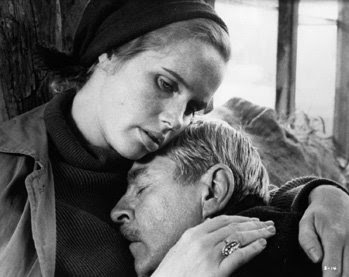
Shame opens in a darkened bedroom with two people sleeping in separate beds. An alarm clock rings, and one of the two figures stirs but does not rise. The other figure, a woman, snaps awake, sleepily gets out of bed, flings open the curtains, flooding the room with light, and walks to a jug and basin and begins washing. The first figure, a man, lingers in bed a few moments then slowly sits up, puts on his eyeglasses, takes a pill of some kind, and sits there with a stony and dispirited expression on his face. The two people are Eva Rosenberg (Liv Ullmann) and her husband Jan (Max von Sydow), former violinists in a symphony orchestra that has disbanded because of the war and who now live as refugees in a primitive farmhouse on a remote island, where they grow lingonberries. Their existence here is not so much one of bleakness as of life reduced to its essentials. Their house is lit with oil lamps but they have a battered old station wagon, and a telephone and radio that sometimes work.

Later they sit at the table eating breakfast. She is dressed and ready to begin their day, which will consist of taking the ferry to another island to deliver two boxes of lingonberries. He sits in his pajamas, unshaven, and tells her of the dream he had—that they were once again playing in the orchestra and that the life they live now was behind them, like a nightmare. "I woke up crying," he says to her. This first sequence tells us a great deal about these two people by showing us the way war has affected them and influenced the dynamics of their relationship.

Eva is resilient. Self-controlled without quite being cold, she organizes and regulates their life together. She has not lost her capacity for pleasure even in the face of the straitened conditions and political uncertainty in which they live. When they sell their berries for more than they anticipated, she suggests buying a bottle of wine to celebrate. Nor has she altogether abandoned hope for the future. As they drink the wine together outside under a tree, she talks animatedly to Jan of her love for him and her desire for children.

Jan, on the other hand, is close to being a broken man. Like most depressed people, he has turned inward, dwelling on his misery, and with the exception of Eva seems scarcely able to connect to those around him. Moody and withdrawn, he is emotionally dependent on Eva's nurturing strength and barely able to keep going from day to day. He can no longer even play his instrument. He may even be impotent. Not only do they sleep in separate beds, but Eva's talk of children, of their emotional commitment to each other, and of their future clearly makes him uncomfortable. He accuses her of being angry all the time; she accuses him of being weak. "Pull yourself together," she tells him at one point, impatient with his self-pity. "I do."

So far Jan and Eva seem to have adjusted to their life in exile, and if they must endure a certain amount of physical deprivation, at least they appear to have escaped the conflict raging on the mainland and to live in relative safety. Their comparatively peaceful life soon collapses though. As they sit under the trees sipping their wine and chatting, the rural silence is suddenly shattered by the scream of low-flying jet fighters racing across the sky. One of the planes explodes, and running toward the wreckage, Jan finds its pilot hanging from a tree. From this point on, Jan and Eva experience the full gamut of the horrors of war.

Their farm is invaded first by enemy troops, then by local troops. Arrested and accused of collaboration with the enemy, Jan is interrogated and beaten while Eva listens from the next room. They are subjected to stage-managed psychological intimidation then arbitrarily told by Mayor Jacobi (Gunnar Björnstrand), supposedly a friend of the couple, to return home. He tells Jan that the authorities knew he wasn't a traitor, "but we had to make an example of you." Making their way home, Jan and Eva wander through a stark, bombed-out, burned-out landscape of devastation.

After returning home, they are visited by the mayor, who makes an overt sexual pass at Eva while Jan looks on. Later Jan sees them together in the greenhouse, where they appear to be having sex. At this point guerrilla fighters, who have been hiding in the woods, show up looking for the mayor and in a powerfully dynamic sequence completely wreck the house, smashing everything in it, and finally blowing it up. During this long sequence the only sounds are those of the house being destroyed. Afterward, Jan finds his antique violin lying outside in the dust, smashed to pieces, and this, along with the discovery of what he believes to be Eva's betrayal, is the final blow to his humanity. The loss of the last meaningful connection to his former life and of Eva's fidelity causes him to lose his moral bearings completely: when the guerrillas put a pistol in Jan's hand and demand that he execute the mayor, at first he drops the pistol in revulsion, then hesitantly picks it up and shoots the mayor several times.

This is the first but not the last time in the movie that Jan kills. After the guerrillas leave and Jan and Eva are living in their greenhouse, an exhausted young soldier turns up, and Jan seizes his rifle and leads him down the road. Jan returns alone, carrying the young soldier's shoes, and tells Eva that a boat will be leaving for the mainland soon. Shocked at what Jan has apparently done—"You killed him for his shoes?" she asks, incredulous—and at what he has become, she at first refuses then agrees to go with him. The last scenes in the movie show the couple clinging to each other as they drift, along with a handful of other refugees, in a small open boat on a vast sea that fills the frame.
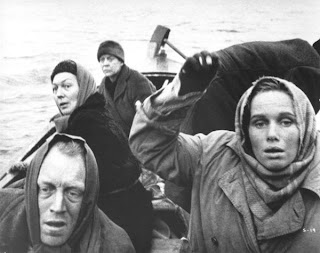
By stripping all specific context from the war happening around Eva and Jan, Bergman focuses on the human effects of war on those unwillingly caught up in it, making Shame one of the most moving of all anti-war films. Jan and Eva are completely apolitical. They don't understand what this war is about, and they support neither side. The thrust of the film is entirely on the effects war has on these two people, who are trapped in an unreal situation and want only to avoid its harsh consequences.

Yet the war's toll on them is great. It destroys Jan, causing him to lose not only his dignity, but also his humanity. Bergman may allow the camera to linger almost obsessively on Liv Ullmann's expressive face, radiant in its unadorned, earthy beauty. But it is really von Sydow, his face growing progressively more haggard and his expression more tormented as he slowly unravels under the soul-destroying experience of life during wartime, who is the center of the movie. The war also destroys Jan and Eva's marriage by turning their relationship from one based on love and shared values to one based on necessity and desperation. A relationship based on the desire to share a common future devolves into one based on dependence on each other for physical and psychological survival, and characterized not by mutual respect but by mistrust and suspicion.

Shame, like Bergman's best films, strikes a precisely calibrated balance between the thematic and the narrative. I have always thought of Bergman as the most literary of the great film directors. By this I mean that his movies function simultaneously on both the intellectual and the human levels. His movies deal with ideas, but they also deal with complex and clearly defined individuals interacting in compelling situations. Perhaps it is Bergman's background in theater that accounts for this ability to explore weighty, abstract subjects through emotionally engaging stories that are both personal and specific.

Shame is an incredibly dense movie. At just 103 minutes, fairly short by current standards, it is far richer in narrative incident than my cursory description of the plot indicates. Bergman weaves into the film's plot incidents that touch on a remarkable number of the ramifications of war—among them the control of entire populations through mass psychological manipulation, the use of film as a propaganda tool, the devaluing of beauty and art, and the sanctioning of inhumane impulses that would never be tolerated in peacetime. Its quiet early section—with its depiction of a static, almost ascetic life—draws the viewer in before suddenly giving way to a vision of constantly accelerating instability and the inexorable disintegration of the tentative security that Jan and Eva have found in their island refuge. Its visualizations of the violence and destruction that occur as a result are memorably vivid and truly harrowing.

Bergman's perennial subject is personal suffering. In Shame the source of this suffering is not internal and spiritual as in so many of his films, but external and specific. Shame deals not with existential pain, but with man-made pain. In this sense, it is a movie for those wary of Bergman. There are no dreams or hallucinations, no religious allegory, no obscure symbolism, no abstruse reality-and-illusion puzzles. Its plot is calculated to drive home in a realistic way the simple message that war is humankind's most cruel and dehumanizing creation. By limiting the scale of the military conflict in the movie and concentrating on its toll on ordinary non-participants, Bergman created a timeless anti-war film that still has great relevance more than forty years later. If you have any doubt about that statement, just watch a news program or read a newspaper with good international coverage, and note how many stories deal with small-scale regional conflicts like the one depicted in Shame and their effects—the fear, pain, confusion, and humiliation—on local populations and on individuals like Jan and Eva Rosenberg.

Monday, April 27, 2009

Hiroshima, Mon Amour: The Necessity of Remembering

Alain Resnais's Hiroshima, Mon Amour—along with François Truffaut's The 400 Blows and Jean-Luc Godard's Breathless—is one of the three films that in 1959 launched the French New Wave movement in cinema. Although lumped together as New Wave films, each has a distinct character that expresses the personal vision of its director, an illustration of the auteur theory the New Wavers believed in so ardently. But as different from each other as these movies are, what they all have in common is the way they take the conventional elements of film narrative and synthesize them in unconventional ways—if you will, the way they take the language of movies and rearrange its syntax in unexpected and inventive ways.

Truffaut's The 400 Blows is in style the most conventional of the three. Godard's Breathless is more daring in its startling modulations of tempo: uptempo passages of rapid action filled with jump cuts are juxtaposed with mid-tempo passages of long, fluid tracking shots and slow, nearly static passages consisting largely of lengthy conversations between Jean Seberg and Jean-Paul Belmondo. Of these three seminal films, Resnais's Hiroshima, Mon Amour is the most innovative departure from cinematic conventions and the most highly stylized.

The movie concerns a French actress (she is never named) played by Emmanuelle Riva, who is in Hiroshima, Japan, to play a nurse in a movie about the aftermath of the nuclear bombing of the city, and the brief romance—two nights and one day—she has with a Japanese architect (also never named) played by Eiji Okada. In the first section of the movie, Resnais, at the time a well-known maker of documentary films, creates a long montage composed of several elements: tight close-ups of the intertwined limbs and torsos of Riva and Okada, archival newsreel-style footage of the ruined city (along with what appears to be some re-creations, possibly intended to be from the movie Riva is making), documentary shots of the victims of the bombing—burned, maimed, and deformed from birth defects as a result of the radiation—more documentary shots of the historical museum and its exhibits of the effects of the bombing on the city and its inhabitants, and shots of the modern city taken from a moving vehicle.

During this section of the movie, Riva narrates in voice-over the horrifying details of the bombing, which were followed in the days afterward by spontaneous demonstrations by the residents of Hiroshima, in which she says they expressed their "anger against the inequality advanced by one people over another . . . by certain races against other races . . . by certain classes against other classes." These sentiments, taken with the scarifying images of the devastated city and the horribly mutilated victims of the bombing, leave no doubt about the anti-war and anti-nuclear weapons sentiments of Resnais and Marguerite Duras, who wrote both the screenplay and the novel on which it is based.

It is only well into the movie that the camera finally pulls back to reveal the faces of Riva and Okada; until this point they have existed only as isolated body parts and disembodied voices without identity. This second section of the film, which begins around daybreak, concentrates on the romance between its two main characters, and gradually something resembling a plot begins to emerge. The next morning they breakfast, bathe, dress, and leave the hotel together—she in her costume, a nurse's uniform—for the movie set, where it is her last day of filming. Later that day they return to the hotel, and during this third section of the film we learn from their pillow talk much more about the two characters.

From this point on, the focus of the movie becomes Riva's character. Earlier that morning, just after she got out of bed but while Okada was still in bed, she walked back into the room and saw him lying stretched out on the bed. Just for an instant we saw, from her point of view, another man stretched out in the same position, this time clothed and with what appeared to be blood on him. Now as the two lovers spend their last day together in the hotel room, we begin to learn more about Riva's past as she tells Okada about herself, her reminiscences initiated by the confession that she once had a nervous breakdown.

Scenes from the present in the hotel room alternate with scenes from Riva's past as a teenager in rural France during World War II. The scenes set in the present are presented chronologically, while the scenes from the past are presented in a non-linear, stream-of-consciousness order. The details Riva tells Okada about her past allow the viewer to piece together incrementally a complete backstory that explains her present psychological state. Resnais and Duras do this in such a way that what might have been a confusing jumble slowly becomes a coherent narrative as bits and pieces of her experiences are revealed.

Today such an approach doesn't seem all that startling; it's even seen in more artistically daring television shows. But when this movie was made, it must have seemed a radical experiment. Movies had been starting at the end of the story, using frame stories and flashbacks, and jumping back and forth in time for quite a number of years. (Think of Le Jour se Lève and Citizen Kane, the more intricate screenplays of Joseph L. Mankiewicz, or any of a number of movies from the 1940s.) But such shifts were carefully cued to viewers by devices like voice-over narration, slow fades or dissolves, the image going out of focus, montages, or superimposed titles. Hiroshima, Mon Amour was perhaps the first movie to expect the viewer to follow the spontaneous stream-of-consciousness shifts of twentieth-century literature.

The character Riva plays is a fascinating and complex one. As she reveals more about herself, she becomes more agitated and more disinhibited, and we are able to see that she is a mercurial person subject to sudden moodswings and that the origins of her present emotional instability lie in her wartime experiences. Her intimacy with Okada and her presence in Hiroshima have liberated buried emotions and allowed her to relate them, possibly for the very first time, to another person. Like the city of Hiroshima itself, she is still suffering the devastating aftereffects of almost unimaginable wartime trauma.

The ultimate revelations—which involve a love affair with a German soldier, his killing by the Resistance, her discovery of his body (the brief flash we saw earlier), being shunned by the villagers as a collaborator, having a nervous breakdown, and being locked in a cellar—are made to Okada that night in a tea room in the city. During this episode, the film reaches its climax when Riva becomes hysterical and begins to lose control of herself. Up to this point, Okada has been essentially a passive character, acting as a catalyst to encourage Riva to tell her story and confront the horrific memories that have had such a devastating effect on her. Now he takes an active role to prevent her from going over the edge into madness again.

In desperation, he suddenly reaches out and gives her two sharp slaps on the face. These slaps resound on the soundtrack like thunderclaps. and at that moment all the ambient sounds of the tea room—the noises from the kitchen, the conversations of the other patrons, the juke box, the street noises from outside—are suddenly heard at quite loud volume. We realize that during the last parts of this sequence the only thing on the soundtrack has been Riva's voice. In a kind of aural equivalent of the subjective camera technique, where the camera shows the viewer what a character is seeing, the soundtrack has taken on the aural subjectivity of Riva. So hypnotized has she become by the experience of finally telling her story that she has withdrawn completely into her memories. With the slaps that break her reverie, we literally hear her re-enter the present, the here and now.

The concluding section of the movie shows the aftermath of the experience in the tea room. Shattered and disoriented, Riva wanders the nighttime streets as Okada follows her. For the last day he has been imploring her not to return to Paris but to stay in Hiroshima with him, and she has consistently refused. Around dawn she returns to her hotel room, where Okada finally catches up with her. Here she confesses to him that losing him would have as profound an effect on her as losing her first lover did; in a way, her emotional state has taken on a circular aspect, her emotional past merging with her emotional present.

In the enigmatic final scene, the couple are finally given identities of a sort: he says that he will call her Nevers (the name of the French village she came from), and she says that she will call him Hiroshima. Is it possible that the emotional gulf she has placed between them is at last closing? Whatever else this exchange may mean and whatever it may foreshadow for the future of the couple, it clearly indicates that at last they grasp the point Resnais and Duras have been aiming for: that we are—each of us—our own past, that our present identities are inseparable from our past experiences.

To say that Hiroshima, Mon Amour is about recovering repressed memories would, I think, be an oversimplification. It is more accurately about finding memories that have been lost, about rediscovering memories that have been forgotten. "Like you," Riva says to Okada at one point, "I have struggled with all my might not to forget. . . . I forgot." In the years since the events of her girlhood, Riva's traumatic memories have been assimilated and relegated to the background. But the experience of being in Hiroshima, where the reality of the past is inescapable, compels her to see that the same is true of her own life, that her past will always coexist with her present. "Why deny the obvious necessity of remembering?" she asks.

This is why the idiosyncratic style of Hiroshima, Mon Amour is not just a contrived stunt. Resnais's blending of documentary and fictional film and his non-linear and non-logical intermingling of events from Riva's present and her past replicate the subject and theme of the movie. Whereas Truffaut and Godard looked to American movies for inspiration, Resnais looked to literature. Hiroshima, Mon Amour is a very conceptual and very literary movie. It attempts to translate the literary techniques of the writers of the French nouveau roman movement, with their extreme authorial subjectivity and stream-of-consciousness fusion of past and present, into cinematic terms. Alain Robbe-Grillet, who wrote the screenplay for Resnais's Last Year at Marienbad (1961), was the initiator of the movement, and Marguerite Duras one of its best-known practitioners. There is moreover a history of preoccupation with the nature of time and memory in both French philosophy (Henri Bergson) and French literature (Marcel Proust).

Hiroshima, Mon Amour was not the first film in which Resnais explored the way the past coexists with the present and constantly exerts influence on it. His best-known earlier documentaries Night and Fog (1955) and Toute la mémoire du Monde (1956) explored variations of this theme: the former in its examination of the Holocaust as viewed from a contemporary perspective, the latter in its examination of the Bibliothèque Nationale of France in its role as repository of the history of written knowledge. Nor would Hiroshima, Mon Amour be the last film in which Resnais dealt with the complicated relationship between past and present, forgetting and remembering.

With its unexpected shifts in time and place, tone, emphasis, and style, Hiroshima, Mon Amour is not a movie to watch casually. The only way to watch it is to surrender yourself to the film, to let it carry you along until you become acclimated to its style and rhythms and its story begins to emerge. This is not a filmmaking approach I would care to see often, particularly in less capable hands than those of Resnais. Occasionally both the forcefulness of the style and the sometimes overwrought pitch of the narration do threaten to overwhelm the emotions expressed in the story. But it is a unique movie, a real one-of-a-kind, a movie which is not only part of a historically important movement in film, but which has in its own right had great influence that can still be seen in movies today. As such, it should be watched by anyone seriously interested in film as an art form.

Monday, February 9, 2009

Brief Reviews

THE SCARLET EMPRESS (1934) ***½
The director Josef von Sternberg was hardly a modest man. In the 1967 BBC documentary The World of Josef von Sternberg, included on the Criterion DVD of The Scarlet Empress, he claimed total creative authorship of his movies—not only writing and direction, but also production, lighting and photography, and editing, whether he was credited with these in the completed film or not. It's little wonder then that the American auteurist Andrew Sarris named von Sternberg one of his "pantheon directors," praising his mastery of visual technique and describing him as "a lyricist of light and shadow." The Scarlet Empress is a mind-bogglingly baroque surfeit of visual detail, by turns ravishingly beautiful, lushly decorative, and hauntingly bizarre. Many scenes contain as much visual embellishment—in set decoration, props, costumes, and human spectacle—as I've ever seen in one movie. And still von Sternberg manages to arrange all these objects (including the actors, whom he refers to in the documentary as "marionettes") in these elaborate settings with clarity and purpose. Of the great directors, perhaps only Eisenstein, Kurosawa, and Orson Welles were as skillful as von Sternberg at organizing objects within the frame to create mood and emphasis.

In The Scarlet Empress, Marlene Dietrich, who made seven movies with von Sternberg, plays the lead role, Catherine the Great of Russia. She is required to transform from a young innocent—engaged through an arranged marriage to the future Tsar Peter III (Sam Jaffe), a childish madman—into a mature woman who uses sexual favors to engineer his assassination and seize the throne. (The historical accuracy of this is debatable.) She is quite convincing as she proceeds from naiveté to a kind of survivalist acceptance of her situation and finally, after a binge of sexual libertinism, to the decision to take control of events. Is she a cunning schemer, or does she truly want to rescue the Russian people from the insane tyranny of her husband? Von Sternberg keeps the answer ambiguous.

Jaffe, with his goofy buck-toothed grin and wide-eyed leer, is appropriately demented. And Louise Dresser turns in a broad semi-comic performance as Peter's dissolute and manipulative aunt, the Empress Elizabeth. Still, the strong impression these performers make pales beside the one von Sternberg makes as the absolute, perfectionist master of his startling cinematic vision.

H. M. PULHAM, ESQ. (1941) ***½
King Vidor directed all or part of 67 pictures between 1913 and 1980, more than half of them silent. Along with some bona fide classics, he also directed two of the worst movies I've ever seen, Duel in the Sun (1946) and The Fountainhead (1949), so I approached this movie with some trepidation. The story of a privileged member of a rich Boston society family from birth to middle age, the movie opens with a striking, nearly silent sequence showing Pulham's (Robert Young) morning routine—from waking up to arriving at his law office at exactly 9:00 a.m.—that within just a few minutes plainly establishes the regimented sterility of his life. The rest of the movie is structured as an alternately serious and whimsical stream-of-consciousness narrative that moves between scenes of the present and the past as Pulham recalls his entire life from birth to the present.

As I watched, I was amazed at the fluidity of the direction and at how natural Vidor made the rather literary structure of the movie seem. Young, with his subdued and rather bland screen presence, was ideally cast in the title role. The most interesting parts of the movie are those that deal with Pulham's life in New York City immediately after World War I working as a copywriter in an ad agency. In doing this, he is defying his father (Charles Coburn), who wants him to come home and join the family law firm. For a while it appears that Pulham will escape the stultifyingly conformist future that awaits him in Boston, especially after he begins a romance with a fellow copywriter, Marvin Myles Ransome (Hedy Lamarr), an independent-minded woman who encourages him to break away from the stifling traditions of his class and heritage. Lamarr's freethinking character is one of the best things in the movie. She seems surprisingly modern, wanting a career and her own life over marriage and a family, and Lamarr gives an excellent performance. But it is precisely her (for the time) unconventional values, combined with circumstances which force Pulham to return to Boston and his family, that ultimately separate them.

The ending is a bit pat—and with its message that you can't escape your background, a bit disturbing in its complacency—but the rest of the movie is delightful, a felicitous mixture of excellent acting, writing, photography (by Ray June) and editing, with Vidor's assured direction holding it all together.

DOWNSTAIRS (1932) ***½
I must confess to having a fairly low tolerance for movies of the early 1930's. Even the most highly touted of them often disappoint me. Downstairs, though, proved to be a pleasing exception. It stars John Gilbert, who wrote the story himself, and the whole movie is built around his character.

The movie opens at the Mitteleuropean estate of a baron whose head butler Albert (Paul Lukas) is being married to Anna (Virginia Bruce), the personal maid of the baroness. Into the festivities walks Gilbert as Karl Schneider, the new chauffeur. Karl is an unrepentant cad who immediately proceeds to charm, lie, blackmail, and seduce his way into a position of power and influence both upstairs and downstairs, managing to outwit and outmaneuver everyone who tries to expose him. In particular he sets his sights on the luscious but innocent Anna. After the stuffy Albert discovers that Karl has indeed seduced her, Anna looses an astonishingly frank tirade that not only makes clear that Karl's power over women lies in his sexual prowess, but also strongly asserts the desire of women to enjoy sex as much as men do and be treated by men as equal sexual beings.

Besides its surprisingly modern sexual attitudes, Downstairs has several other things going for it: an amusing take on amorality among the rich, its satirical mockery of the class system, and very entertaining supporting performances by Reginald Owen as the "silly ass" baron and Olga Baclanova (Freaks) as the conniving baroness. Monta Bell, who did such a great job on the Norma Shearer silent Lady of the Night (1925), directs with great seriocomic flair and provides some nice auteurish visual touches, including those in the scene where Karl seduces Anna, and later when he dissolves from the sleeping Anna to the next scene with Karl so slowly that for a few moments Karl seems to be a hazy dream image hovering over her bed. This movie and Queen Christina, which Gilbert made the next year with Garbo, should put to rest in any viewer's mind the notion that Gilbert's career ended because he was unsuited to sound films.

TWELVE O'CLOCK HIGH (1949) ****
I'm not a big fan of war movies. Nor am I a big fan of Gregory Peck, whose performances often strike me as wooden and unengaging. Yet I found both this movie and Peck's performance in the lead role outstanding. In Twelve O'Clock High the emphasis is not on combat, but on psychology and characterization. In England in 1942, the first American Army Air Force crews have arrived and are starting the first daytime bombing raids over Europe. (The British RAF flew only nighttime raids.) The number of squadrons is small and support is minimal. Although the war planners are convinced that in time this strategy will prove the decisive factor in winning the war in Europe, at the moment the missions are having little real effect. Losses of aircraft and crews are high, understandably leading to great stress and low morale among both men and officers. One bomber squadron, based at Archbury, in particular is experiencing problems, and General Savage (Peck) is assigned to replace his good friend Col. Davenport (Gary Merrill) as commanding officer of the squadron.

In early scenes Savage has been established as a nice guy but a shrewd analyst who believes that the problem with Davenport is that he has grown too close to his men and lost his objectivity. So when Savage arrives at Archbury and immediately begins behaving like a cold martinet, we know that this is a role he is playing, a psychological ploy devised to instill the spirit of selflessness and teamwork among his fliers. "Consider yourselves already dead and you won't have to be afraid of it happening," he tells them at his first briefing. The initial response is not good, especially after his unsympathetic treatment of a popular navigator results in his suicide. But Savage finds one man, the deskbound Maj. Stovall (Dean Jagger, in an Oscar-winning performance), who understands his tactics and is willing to help him. Slowly his efforts pay off and the squadron comes into shape. It is only towards the end of the movie that we actually go on a bombing mission, with Gen. Savage leading the formation, in an exciting and deeply affecting sequence.

The treatment of the characters and situations by director Henry King is refreshingly unsentimental and unjingoistic. One can easily imagine the heavy-handed treatment such a plot would have received in the hands of a less subtle director. Peck too is uncharacteristically subtle. His rather stiff acting style makes his "performance" as a by-the-rules martinet believable, while he also manages to suggest the true, more sensitive feelings of the character that lie beneath the surface. The movie runs a little over 2 hours 15 minutes yet doesn't seem that long. And by not fawning for the viewer's admiration, it earns our sincere respect. Few movies about World War II made so soon after the event have aged as gracefully as Twelve O'Clock High.
Related Posts Plugin for WordPress, Blogger...